Built around how ecommerce warehouses actually work.
OptiWMS fills the gap between pick-and-pack apps that are too basic and enterprise WMS platforms that are too expensive and too slow to implement.
Why we built it
Built by people who have done the work
OptiWMS comes out of years working in B2C logistics: warehouse floors, fulfillment operations, and the daily grind of getting orders out the door on time. The people who designed each workflow have stood at the pack bench and run the pick face themselves.
The same gap kept showing up: the lightweight pick-and-pack tools could not run a real operation, and the enterprise platforms cost six figures and took months to stand up. OptiWMS sits in that middle ground, a full WMS that a new operator can learn in an afternoon, built around how multi-channel ecommerce brands run their own warehouse.
What we stand for
The principles behind how we build and what we ship.
Fast to deploy
Connect your store, import your products, and your first real order is flowing through OptiWMS by the end of the week. It runs on the laptops you already have, and your warehouse team picks it up the same day.
Operator-first design
Built on years of warehouse floor experience. The pick queue, receive flow, and pack station are each laid out for someone holding a scanner in one hand and a parcel in the other, where one extra tap per order adds up across a shift.
Multi-channel native
Orders from Shopify, WooCommerce, and eBay land in one pick queue the moment each store confirms them. Variant-level inventory, size and color pick lines, and fulfillment push-back with tracking on every channel. New platforms connect through the same open GraphQL API.
Security first
Role-based access, per-warehouse scoping, and a full audit trail for every inventory movement. Every pick, adjustment, and user action is recorded.
The whole cycle
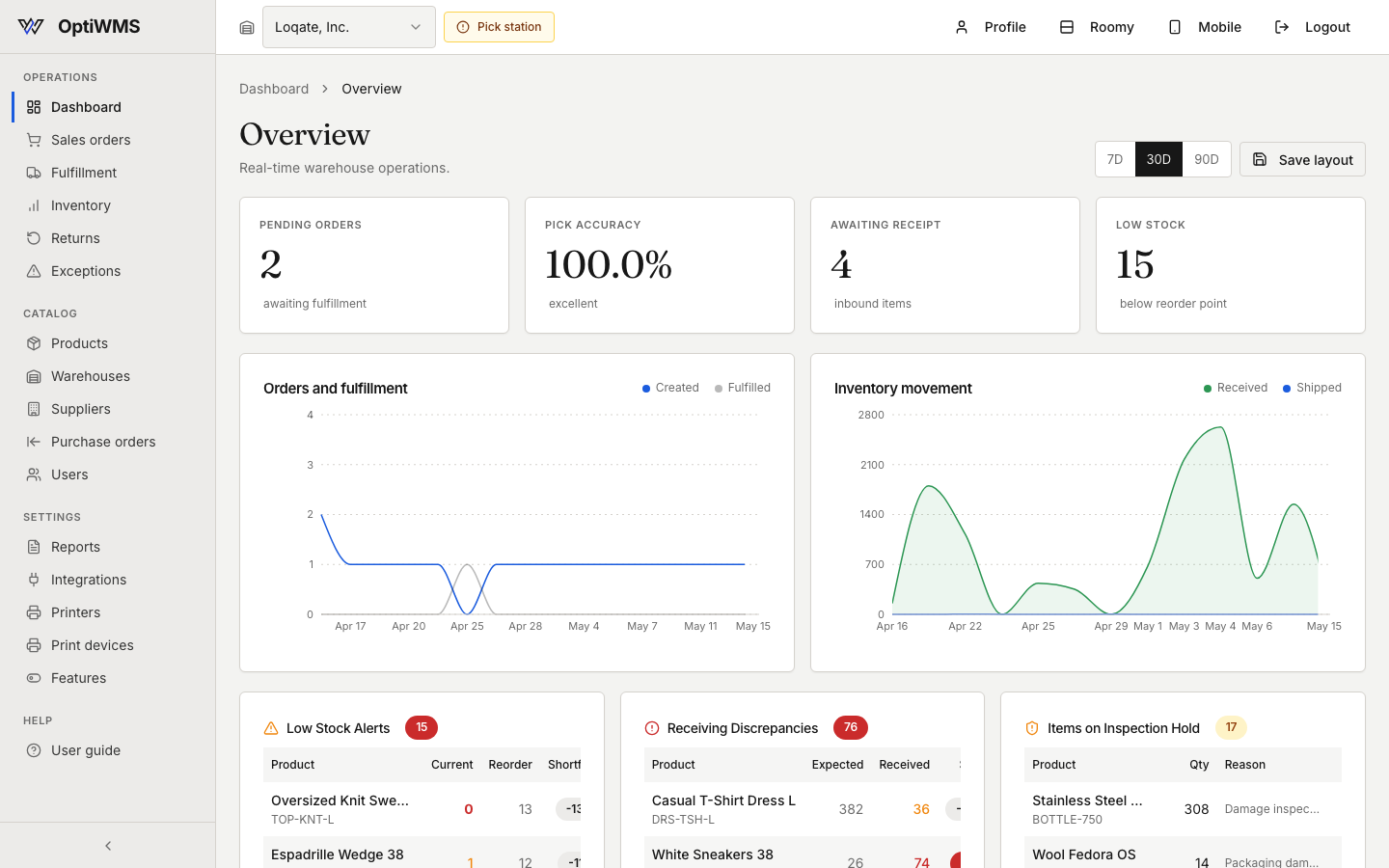
Receiving, inventory, picking, packing, dispatch, and returns in one product, with native store sync, labels created at pack time, barcode-driven operations, and built-in thermal printing.
API-first and open
Inventory positions, order state, fulfillment progress and the print queue are all queryable. Build integrations, custom dashboards or AI-driven automations on your own timeline. Nothing is held back for an enterprise tier, because every screen in the dashboard runs on that same GraphQL API.
See it running on your own catalog.
Start a trial and we will set up a sandbox tenant with seeded inventory, variant-level SKUs, open orders, and a connected store. Run the pick-pack-print cycle before you commit a cent. Or book a 30-minute demo and we will walk you through a live tenant with your actual catalog.